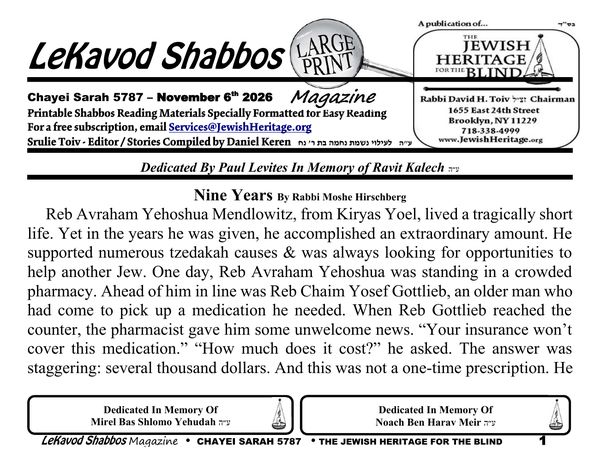
Extra Large Print edition · 24 pages · 11 × 8.5 in, landscape · Body text in 21-point type, about twice the size of regular print · Prints on any home printer.
This is the size of the print in Lekavod Shabbos.
Nine Years
By Rabbi Moshe Hirschberg
Reb Avraham Yehoshua Mendlowitz, from Kiryas Yoel, lived a tragically short life. Yet in the years he was given, he accomplished an extraordinary amount. He supported numerous tzedakah causes & was always looking for opportunities to help another Jew. One day, Reb Avraham Yehoshua was standing in a crowded pharmacy. Ahead of him in line was Reb Chaim Yosef Gottlieb, an older man who had come to pick up a medication he needed. When Reb Gottlieb reached the counter, the pharmacist gave him some unwelcome news. “Your insurance won’t cover this medication.” “How much does it cost?” he asked. The answer was staggering: several thousand dollars. And this was not a one-time prescription. He would need the medication every month. Reb Gottlieb realized that he could not afford it. He turned away from the counter, prepared to leave without the medication. Reb Avraham Yehoshua had overheard the exchange. After Reb Gottlieb walked away, Reb Avraham Yehoshua approached the counter. “How much is the medication?” “A few thousand dollars.” “Put it on my credit card.” The pharmacist looked at him to make certain he understood. “You realize this isn’t just for today. He needs this medication every month, & it will cost several thousand dollars each time.” Reb Avraham Yehoshua barely paused. “Then charge my credit card every month.” A Jew needed medication, & Reb Avraham Yehoshua had found a way to provide it. The matter was settled. Two weeks later, as Reb Avraham Yehoshua was responding to a Hatzalah call, he suffered a massive heart attack. It was extremely serious. Yet, b’chasdei Hashem, paramedics was nearby, & his life was saved. Against the odds, Reb Avraham Yehoshua survived. Life continued. So did the monthly charges. Month after month, year after year, Reb Avraham Yehoshua paid for Reb Gottlieb’s medication. Several thousand dollars at a time went onto his credit card, without Reb Avraham Yehoshua seeking recognition for what he was doing. Nine years passed. On the Shabbos before Selichos, 5787, Reb Gottlieb passed away. His medication was no longer needed. Just a few hours later, the first night of Selichos, Reb Avraham Yehoshua Mendlowitz suddenly collapsed. He, too, passed away. Only then did the remarkable sequence of events come into sharp focus. Two weeks after Reb Avraham Yehoshua had undertaken to pay for another Jew’s life-sustaining medication, he had suffered a heart attack that could have ended his own life. Instead, he was granted another nine years. For those same nine years, he silently paid for Reb Gottlieb’s medication. And when Reb Gottlieb no longer needed the medication, Reb Avraham Yehoshua’s additional years came to an end as well. We cannot know the calculations of Shamayim. But the timing has a remarkable message: For nine years, Reb Avraham Yehoshua quietly helped sustain the life of another Jew. And for nine years, his own life was sustained. Nine years of tzedakah. Nine years of life.
I was born with a hole in my heart — otherwise known as an atrial septal defect — where a fissure exists in the wall separating the heart’s two upper chambers. This defect was discovered when I was two years old, but it was not life-threatening & the complicated surgery — which would be necessary in the future — could wait until I was a teenager. The time finally came when I was 17. Back then, an operation to repair a hole in the heart was much more rare-and-risky than it is today and, certainly, “open heart surgery” was very scary to me as a teenage boy. As it turned out, the [Lubavitcher] Rebbe had a great deal to do with putting me at ease. By way of background, I was raised in a traditional, though not completely Torah-observant, home. Nonetheless, my widowed mother wanted me to get a religious Jewish education, so she sent me to a local Jewish cheder in Montreal where we lived. One day, however, I came home crying because the teacher slapped me for forgetting my tzitzit, so she pulled me out. Fortunately, an uncle persuaded her not to send me to public school, but to the nearby Lubavitcher yeshivah which had a gentler approach to educating little boys. The yeshivah made an annual trip to New York to meet the Rebbe, & that is how I first met him when I was 12 years old, & then at least once every year thereafter. All along, I had been getting regular check-ups & my heart condition was stable, but I knew that the operation was necessary & would come soon. My mother took out special insurance for this purpose, & it was decided that I would have the operation right after the insurance kicked in & started providing coverage, which was March 1, 1964. About a month before this, I went for my annual visit to see the [Rebbe & I asked for his blessing. I explained my situation & showed him slides of my heart. At around that time, a new procedure had been introduced, as I explained that to the Rebbe. I also mentioned that I had been told that only about a hundred operations like this had been performed so far in Canada. In response, the Rebbe recommended that I get a second opinion from a specialist in this field & said that the local Chabad doctor & his personal physician, Dr. Avrohom Seligson, would find the right cardiologist for me to see. Dr. Seligson set up the appointment right away, but after he already did so, I had to tell him that my mother was a poor widow & there was no way I could ask her to pay hundreds of dollars for something like this. “Don’t worry,” he said simply, “the Rebbe has already taken care of the payment.” So, I went to the specialist who confirmed that the operation was needed & reassured me that it would be okay. Now, when the Rebbe told me to get a second opinion, the operation was already scheduled for a few days after Purim. The Rebbe remarked that this was close to Passover, & I immediately replied that I was certainly happy to postpone it till after. “Why push it off that far?” the Rebbe asked. “Adar [the month of Purim] is a month of mazal!” Then the Rebbe gave me a blessing that the operation would be successful and, as a result, instead of being petrified, I went into the hospital with a whole different attitude. That was not the only time that the Rebbe was instrumental in changing my attitude. After a number of years in the Lubavitcher yeshivah, I had resolved to become a fully-committed chasid, which in my young mind meant growing a beard & wearing my tzitzit outside my pants so they could be readily seen. Now, I should mention that both my mother & father were Holocaust survivors — in fact, I had been born in a displaced persons camp in Germany. Once we immigrated to Canada, my parents were concerned that I properly adjust to life in the new country, speak good English, & so forth. After my father passed away when I was ten, my mother was all the more determined that I should be a success in America. Even though she did want me to have a Torah education, going around dressed like a Jew from the Old Country was a step too far for her, & it really disturbed her. Whenever I was home, she would be nagging at me to tuck the tzitzit inside my pants out of view. And when my beard started growing out, she would be nagging me to shave it off. “Why?” I’d retort, “I am proud to be a Jew!” To which she’d respond, “We don’t do that here!” We’d get into shouting matches whenever the subject came up, which — at a certain point — was almost every night at dinner. Afterwards, I’d always feel terrible because I was supposed to be following the Torah commandment to respect my mother. Not only that, she was a widow, & there are many Torah prohibitions against hurting a widow. And I was bringing her to tears. I very much wanted to be a good Lubavitcher chasid with a beard & tzitzit out, but I also didn’t want to hurt my mother, so I didn’t know what to do. In the end, I laid out my dilemma in a letter to the Rebbe — asking for his advice & his blessing — & I brought this letter with me to the next audience. When the Rebbe read what I wrote, he said (and I am paraphrasing because I don’t remember the exact words): “Concerning the issue that you have with your mother, I suggest that the next time she brings up this subject you don’t argue with her, don’t answer back, just let her say what she feels she needs to say. Just listen to her & sit there respectfully.” I took his advice to heart. The next time my mother asked at dinner, “Nu, when are you cutting off that beard already?” I just sat there. “Moishele, when?! Come on, you want me to cut off your beard in the middle of the night? You know it bothers me!” I just sat there. Didn’t say anything, didn’t fight back, & dinner continued. The next night, the same question, the same response from me. And that was it — the issue never came up again. In retrospect, I realized that the solution was simple — the problem went away when I stopped adding fuel to the fire. As for her part, I think my mother realized that I was going to follow my own path, but that I didn’t want to fight about it, & so she let it go. In the end, my mother herself became much more religious, & she was very proud of her son being a Lubavitcher chasid and, eventually, an emissary of the Rebbe.
“Here’s My Story [with the Lubavitcher Rebbe, zt”l’], a project of the JEM Foundation. Since 1970, Rabbi Moishe Yosef Engel has served as a Chabad emissary in Long Beach, California. He was interviewed in September 2011.
For all Flesh had Corrupted Its Way Upon the Earth.
The Baal Shem Tov, zt”l, once davened Mincha in the forest with great fervor. An astonishing scene occurred: all the animals stood on their hind legs & seemed to join in prayer to Hashem. The Baal Shem Tov explained this through the verse when a person prays to Hashem, it inspires all creation to praise Him as well. He connected this to even the animals were affected by the corruption of man. When people are corrupt, the world around them is also negatively influenced. Similarly, when people serve Hashem with Torah & tefillah, they elevate all of creation, bringing blessing & goodness to the world.
As Refael & Chani Mendlowitz were flying over Connecticut on their return trip from Eretz Yisrael, they sensed that something was terribly wrong. The stewardesses were whispering & running to the front of the cabin. What the passengers didn’t know was that most of the Northeastern United States was in the same panic; a huge blackout had struck many states, & most citizens were sure that this was another terrorist attack. The passengers’ frantic attempts to contact relatives proved futile as cell phones were rendered utterly useless. The initial fear lasted only a short while, until they received word of what had happened & were assured that most likely terrorism was not involved. The more immediate problem was landing the plane without any guidance from on-ground lighting. At first, airport traffic control intended to divert their El Al flight to Washington D.C., & while that was certainly closer to where the Mendlowitzes lived – Silver Spring – it did not help them because their car was in New York at a relative’s home, awaiting their return. In the end, the passengers were told that theirs would be the last plane allowed to land at Kennedy Airport. Once they landed, they were informed that airport security would not allow them to disembark for at least an hour. Hot, anxious, & very thirsty, they were finally released into a darkened airport, where finding their luggage was quite an adventure. Tired & exhausted, they finally exited the terminal & attempted to get a cab. And then the full impact of what had happened hit them. It was an eerie, discomforting sight: All of New York was pitch black. No street lights. No building lights. Nothing! The taxi line stretched for blocks, & since all traffic in the area was slowed due to the lack of traffic lights, they realized that they would be waiting for a cab for hours. While they were pondering their next move, a shuttle bus pulled up, offering to take them where they needed to go for $18, a bargain compared to the $100 the taxis had been charging. They were completely exhausted as they settled in for the short drive. When they reached their relative’s home, they paid the kind driver & thanked him for his assistance. But when Refael tried the key he realized it did not fit; either he had been given the wrong key or had misplaced the right one. Now what would they do? It was midnight of this never-ending day, & they were at their wits’ end. It was then that they noticed a car parked down the street with people in it. Maybe these people live on this street & will let me in so that I can make a few phone calls, he thought. Refael cautiously approached the car. The sight that he beheld brought tears to his eyes. Inside were two men – a father & his son – learning together. They had a set time for their learning, & were determined not to let the blackout change their plans. They had decided that learning in a car, however dimly lit it was, was better than canceling. As for Refael, these men were a sight for sore eyes; and of course, they were more than happy to help the desperate couple. For a long time afterwards Refael could not get the sight of this father & son out of his mind. Imagine, he thought to himself, in a world of utter darkness, a tiny light shines through like a beacon – the light of Torah. “Ki ner misvah veTorah ohr – A misvah is a candle, & Torah is light.”(Touched by a Story 3)
Rabbi David Bibi’s Shabbat Shalom from Cyberspace.
A young Israeli, who grew up in a religious family but veered off the path & gave up his religion, mixed with the wrong crowd & got involved in all sorts of shady behavior. But he reached a point where he was in a difficult, unpleasant position. On the one hand he couldn’t find his way back to his community, either because he was too embarrassed or he felt they wouldn’t accept him again, & the new crowd didn’t really accept him because he didn’t have the same background as they had & he didn’t really resonate with some of their behavior. As a result, he slipped into a terrible depression & eventually reached a point of becoming suicidal. His decided his only option was to find a tall building & jump off the top, ending it all. When he arrived on the top of the particular building he had selected, it ‘happened’ there were some papers flitting about in the wind, & one of them landed right in front of him, within hand’s reach. Out of curiosity he picked it up & took a look. It was an announcement -- the paper said “Today, is the 11th of [the Jewish month of] Cheshvan, the yahrzeit of Rachel Immenu, (our matriarch Rachel). Therefore, buses will be available all day, going to & from the tomb in Beit Lechem (Bethlehem) for anyone who wishes to go pray there” – followed by a detailed schedule. For some incomprehensible reason, that spoke to him. Maybe his childhood memories flared up & he decided that this would be his lastditch attempt at putting his life back together again. Instead of jumping, G-d forbid, he found a bus & went to the kever (burial place) of Rachel. On that date the surrounding structure is always absolutely packed. There is a mechitsa (separating barrier) between the men & the women. He made his way towards the men’s side of the tomb & started to cry that he was in a very desperate place. His prayer was: “Dear G-d, I don’t think that anyone cares about me. My family has rejected me because of my choices; my new friends have rejected me because I don’t really fit in with them. In truth, all I want is to know is that somebody cares about me.” He got so emotional that he actually passed out. A big commotion ensued. Finally, he was taken outside & revived. When he came to, there was a woman standing over him. It turned out it was his own mother! She was sobbing & weeping to see her son who she hadn’t seen for many years, laying on the ground at Kever Rachel! When he was able to compose himself somewhat, he said to his mother, “You have to understand what happened here. I pushed my way firmly to be next to the tomb itself, put both hands on it, & cried out to HaShem. I said, ‘G-d Al-mighty, please show me a sign that there is anybody at all in the world who still cares about me!’ “Within seconds, I heard from the other side of the mechitsa a woman’s voice crying out & saying ‘Please! would You bring back my son.’ And then she pronounced my name & mother’s name! That was so overwhelming that I passed out”. The reunion was the beginning of his rehabilitation & his return to a healthy lifestyle. Mother Rachel still cares!
KabbalaOnline.org, a project of Ascent of Safed in Israel.
Rebbe Mordechai of Zvhil, zt”l, was known for the power of his brachos, even when he was still young & did not yet have a very large following as a Rebbe. One time, someone who was suffering an illness came to visit him & asked for a brachah for a refuah sheleimah, & gave him a large amount of money. Rebbe Mordechai gave him a Brachah, & shortly afterwards, the man was healed. 30 years later, that man’s illness returned to him. By that time, Rebbe Mordechai was known as the Zvhiller Rebbe. The man once again took a lot of money & went to get a brachah from the Rebbe, & requested that the Rebbe please daven on his behalf. The Rebbe replied, “I have a suggestion for you. I know someone who is struggling because he is very poor. Why don’t you take the money you are offering me & give it to him instead? He will also daven for you, & with Hashem’s help, you will have a complete recovery.” The man said, “Rebbe, 30 years ago, I was sick with the same illness, & my Refuah came when I gave money to you & you davened for me, & now I would like to do the same thing & give you money again.” The Zvhiler Rebbe responded, “Thirty years ago, I was a very poor man myself. When you gave me the money back then & had a complete recovery, it was in the merit of giving Tzedakah that you were healed. But now, Baruch Hashem, I don’t need the money. Therefore, I advise you to give your money to the poor. The merit of giving Tzedakah will surely help you recover once again, & I will surely Daven for you again!” The man listened as he was advised by the Rebbe, & shortly after, he was completely healed!
Reb Shimon is an elderly Yid who lives in Yerushalayim. When he was young, before the Holocaust, he lived in Lublin. Rav Meir Shapiro, zt”l, once in a while would come to his Cheder to test the boys, & he would sometimes give out gifts or sweets to the children. One time, Rav Meir Shapiro didn’t have anything to give them, & he said, “Instead of a gift, I will tell you a wonderful segulah, & if you will follow my advice, you will be always be successful & lead a peaceful life!” He then told them about the wonders that happen to people who say Birchas HaMazon properly, & he urged them to always use a Bentcher & not say it by heart. Rav Meir Shapiro concluded, “This is my present to you.” Reb Shimon took the lesson very seriously. He decided right then that he would be careful with bentching for the rest of his life. It didn’t matter to him that his friends would bentch quickly & go out to play, while he stayed behind in order to bentch properly. It was challenging, but he didn’t want to abandon the wonderful gift that Rav Meir Shapiro gave him. A few years later, the Nazis invaded Poland, & Reb Shimon found himself standing in line for a ‘selection’. People who were considered tall, were sent to the right, & were allowed to live, while those who were short were sent to the left for execution. Reb Shimon davened that he should be saved from any “wrath & destruction” in the merit of Birchas HaMazon. When it was his turn, he stood as tall as he could to appear higher, & the Nazi signaled for him to go the right. He attributed his life being saved in the merit of bentching. Soon afterwards, Reb Shimon was standing in line again. This time, each person had to tell the Nazi in charge what his skills were, & Reb Shimon didn’t know what he could say, as he was only a teenager. As he waited in line he davened, “In the merit of Birchas HaMazon, which is a segulah for parnasah, Hashem, please support me.” Suddenly, the person in line behind him tapped him on the shoulder & said, “Tell them that you are a cook & that you are my assistant. I will show you everything you need to know.” Reb Shimon said this & they were both sent to work in the kitchen, where he always had enough food to eat. Again, he attributed this Brachah to his being careful with how he recited Birchas HaMazon. Reb Shimon continued to be extremely careful with bentching, & if he knew that he wouldn’t have enough time to bentch properly, then he wouldn’t eat bread. Once, on a freezing cold winter day, a Nazi saw Shimon working in the kitchen & he wasn’t pleased that he had such a ‘good’ position, surrounded with food. The Nazi ordered Reb Shimon to go outside & showed him a stony area, outside the kitchen, & barked at him, “Dig a two-meter ditch here. You have two hours to finish, or else you will be buried in it,” & he handed him a spoon & said that was all he could use, & then he left. The task was absolutely impossible. The ground was covered with heavy stones, frozen solid, & all he had to use was a small spoon, all to be done in two hours. Reb Shimon raised his eyes to Hashem & said, “I am careful to only say Birchas HaMazon with kavanah. Please save me again in this merit.” A few moments later a German jeep drove by, filled with Nazis, & they saw this young lad trying to dig a ditch with a spoon. To tease him, they threw potatoes, carrots, & other vegetables at him. Reb Shimon just collected them into a pile & continued his work. Shortly afterwards a jeep with Russian workers drove up. When they saw all the vegetables around Shimon, they stopped & asked for them. They were hungry, because they were hardly fed by the Nazis. Reb Shimon told the Russians, “If you help me dig a pit that measures exactly two meters deep here, I will give you all the vegetables.” The Russians jumped at the offer & they all got right to work digging, & as workers, they had exactly the right tools they needed. They all worked together & in just a few minutes they were able to finish the job. They took the vegetables & Reb Shimon went back into the kitchen, far earlier than his deadline. The Nazi was happy to see him, knowing that he certainly failed in his mission, but his happiness ended when Reb Shimon told him the hole was finished. The Nazi ordered him back outside so he could inspect it, & when he saw that it was indeed complete, he said “I always knew that your G-d takes care of you. I just didn’t realize to what extent,” & he never bothered Reb Shimon again. Reb Shimon was saved once again, & he attributed it to the merit of bentching. When he came to Eretz Yisroel after the war was over, he continued to enjoy many brachos of abundance, & he was able to resume saying Birchas HaMazon as he had his entire life!
A poor person earned his parnassah by digging and selling clay. Once, he was digging in the earth, and found a precious stone, worth a great fortune. He went to a jeweler to have it appraised. The jeweler said, "There is no one in this country that can pay for its value. You should travel to London, to the capital city…" But he was poor, and he didn’t have money to travel. He sold everything he owned, and he went from house to house collecting handouts, until he had enough money to travel to the port. He wanted to get on a boat that was heading to London, but he didn’t have money, so he went to the captain and showed him his diamond. The captain immediately welcomed him onto the ship with great honor. "You are surely wealthy." He gave him a first-class private cabin with all amenities, as is given to the very wealthy. His cabin had a porthole to the sea and he would always make himself happy with his diamond. He would especially cherish and look at his diamond as he ate his meals, because joy is good for digestion. Once, he was eating his meal with the diamond on the table and he fell asleep. The cabin boy came in, took the tablecloth with the crumbs on it and dumped them into the sea. He didn’t realize that the diamond was on the table. When this man awoke, he understood what happened, and was immensely distressed. He almost became insane from agony. But he couldn’t afford being sad, because the captain was a crook, and would surely kill him if he didn’t pay for the passage. So he continued to be happy, pretending as though nothing happened. The captain used to come and chat with him for some time every day, and that day, he came as usual. The man pretended that he was happy. It wasn't noticeable on his behavior that anything changed. The captain said to him, "I know that you are wise and honest. I want to buy a lot of wheat to sell in London. I can earn a lot of money from this transaction, but I'm afraid people will say that I'm stealing money from the king's treasury. Therefore, I want the purchase to be on your name. I will pay you well for this." The man liked the idea, and agreed. As soon as they arrived in London and purchased the wheat, the captain died. The wheat remained with this person and he profited several times more than the value of the lost diamond. Reb Nachman of Breslov concluded from this mashal, "The diamond was never his. The proof of that is that it got lost. The wheat was his, and the proof is that its profits remained by him. And the reason he got what's rightfully his is only because he remained happy." We spoke about the importance of being happy, but it isn’t easy for most people. Also, there are many good middos we must acquire, and many good deeds we must accomplish, but people have a yetzer hara, and avodas Hashem isn’t easy. The fact that avodas Hashem is difficult shouldn’t deter us, because if we pass the tests, we become even better than before.
Rav Yaakov Kamenetsky, zt”l, always valued the importance of other people’s time. He kept a small calendar in his pocket in which he recorded the many appointments that he had with people that were looking to meet with him. He would also use the calendar to write down other important things in his schedule, such as Chasunas that he had promised to attend, and various Drashos that he agreed to give. Rav Yaakov was very particular that his schedule should be set up in a manner that people who had appointments with him should not be forced to wait for long periods of time. Once, a Chosson scheduled an appointment with Rav Yaakov for the day of his Chasunah, for 12:00 noon. A few minutes before twelve, the young man received a message from Rav Yaakov that the meeting had to be postponed for half an hour due to an emergency. When the Chosson came at 12:30 for the meeting, he told Rav Yaakov, “Thank you for the message, but I would not have minded waiting half an hour for the Rosh Yeshivah.” Rav Yaakov responded, “I knew that you were probably not coming by yourself to meet me, but someone else who would be accompanying you. I know that you might not have minded waiting, but I could not cause two people to wait for me!”
There was a certain man in Eretz Yisrael who lived in a peaceful area in a quiet apartment building. One day, as he entered the lobby, he saw furniture, beds, sofas, loveseats, recliners, & every kind of furniture imaginable filling the entire space. He had to weave between the various pieces of furniture just to squeeze through & get where he needed to go. One of the residents had decided to open a furniture business in the lobby without consulting anyone else because renting a store was too expensive. The man went to Rav Chaim Kanievsky, ZT”L, & said, "This is eating me alive. I have to squeeze between beds, weave my way through furniture, & hear the commotion of customers when I just want to relax. I want to live a normal life. I want a normal lobby! What this person is doing is completely wrong, & the resentment is eating me alive. On some nights, I even have trouble falling asleep because of it. The chutzpah of this person is unbelievable!” Rav Chaim responded, “You're right. This man is wrong for doing what he's doing. You can take him to Beis Din, & you will probably win. However, it's always good to go above & beyond - to be mevater, to forgive. Sometimes the best thing is to give up on what we want, even when we're right.” The man decided to take Rav Chaim’s words to heart & let it go, despite the difficulty. The next day, this man's son was having fun near one of the windows when he slipped & fell from the third floor. Luckily, one of the extra fluffy beds was there outside the building to break his fall. Had the man not listened to Rav Chaim & instead made a whole tumult, that bed would not have been there the next day to save his son's life. His son walked away unharmed, & the man came away having learned a valuable lesson about the destructive power of resentment -and the incredible greatness of letting things go.
Yechiel had been searching for a shidduch for his son for a long time. His son was an outstanding bochur with many fine qualities, & Yechiel was looking for a girl with exceptional qualities to match. One day, while riding a bus in Yerushalayim, Yechiel overheard the cell phone conversation of the man sitting in front of him. He realized that the man was a shadchan speaking with someone named Shimon, who was looking for a shidduch for his daughter. The shadchan took out his notebook & began recording the details, repeating them aloud as he wrote. He then asked Shimon what type of bochur he was looking for. Yechiel's face lit up. Everything he heard about the girl sounded exactly right for his son, but there was one important detail he still needed to know: the family's origins. He gently tapped the shadchan on the shoulder & whispered, "Excuse me, but an experienced shadchan like yourself would surely ask where the girl's family originates from." "Oh, yes, of course! I forgot. Thank you very much," the shadchan replied, proceeding to ask the question. That detail, too, sounded suitable. What incredible hashgachah pratis! Yechiel thought. Before ending the call, the shadchan asked Shimon for his phone number & repeated the digits aloud as he wrote them down. Yechiel quickly took out his own pen & notepad & recorded the number. That very day, he called Shimon, & a few weeks later, the couple was celebrating their engagement. At the vort, the two mechutanim had a chance to speak, & Shimon asked, "Tell me, how did this shidduch come about? How did you find out about me & my daughter?" Yechiel related the remarkable story of the hashgachah pratis that had brought the shidduch to his attention.
The Weekly Vort. (Excerpted from the book – “Meant To Be.”).
Q&A with Rav Avigdor Miller זצ"ל - Lighting a Yartzeit Candle
Q: What’s the benefit of lighting a candle for a person’s yartzeit?
A: When someone is nifter & candles are lit for that person, it is a kavod for the meis. And that’s because a candle is a beautiful symbol. A flame is a beautiful thing, & even today it’s hard to explain exactly how it works. The physical materials – the wick, the wax, the oil – turn into light. That symbolizes the neshama that was enclosed in a guf & is now only neshama. It’s now ohr. Like the ohr of the candle that has been transformed from physical materials into light, the guf has been transformed into neshama. And the neshama is now ohr, shining in Olam Habah. And when we light the candle & show that we recognize this truth, it gives nachas to the neshama. When someone passes away, that person doesn’t stop existing. The neshama is real & it is existing in Olam Habah. And the neshama can still feel & recognize these things. So when the nifter is honored by the family when they light a yartzeit candle, it is a nachas ru’ach for the neshama. The symbol of the light that comes from the wax & the wick is an important thing. And ohr is a tremendous thing. Not only the sunlight. But even artificial light is such a gift! Every מוצאי שבת we make a special bracha on artificial ohr. Borei me’orei ha’aish. A bracha on fire, on electric light, on other lights. It’s a great blessing to have artificial light. And therefore, the light of the candle is a beautiful symbol. It’s a symbol for the neshama that has turned from gashmi’us into ruchni’us. And the neshama in the next world is happy that people are lighting the candle & recognizing the truth of the Next World. It’s a nachas ru’ach for the neshama.
Rabbi Meir Orlian’s Business Halacha Institute – Skylight Rain
Before leaving, they packed their luggage, unplugged appliances, & double-checked that everything was in order. “Did we forget anything?” Mrs. Sorscher asked as they loaded the last suitcase. “I don't think so,” replied Mr. Sorscher. “Let's hit the road! It's been years since we took a real family vacation!” The weather was beautiful as they pulled away. A week later, however, an unusually fierce thunderstorm swept through the area. Powerful winds lashed the neighborhood, & torrents of rain pounded the rooftops for hours. Only after returning home did the Sorschers discover what had happened. A skylight in their attic apartment had been left half open. Rainwater had poured inside, pooling on the floor for days. By the time the water finally dried, much of the hardwood flooring had warped beyond repair. Mr. Rubin, the landlord, arrived later that afternoon to inspect the apartment. He stood silently for a few moments, then slowly shook his head. “This isn't just a few damaged boards,” he said. “The entire section of flooring will have to be replaced. You're liable for the cost.” Mr. Sorscher looked genuinely distressed. “I can't believe we overlooked the skylight,” he admitted. “It was sunny when we left, & the thought never even crossed my mind.” “But you were away for two weeks,” replied Mr. Rubin. “Leaving a skylight open that long is negligence, not an unavoidable accident. And our lease specifically states that the tenant is responsible for damage resulting from negligence!” “I learned, though, that the Torah exempts guardians of real estate from liability,” answered Mr. Sorscher. "Since a renter is like a shomer, perhaps that applies here.” “Maybe in theory,” Mr. Rubin replied, “but does that exemption apply when someone is careless? And even when there is a clause in the lease?” The two came before Rabbi Dayan & asked: “Are the Sorschers liable for the damage to the flooring?” "A renter (socher) is parallel to a paid guardian (shomer sachar)," replied Rabbi Dayan. "He is liable for theft & loss, but exempt with an oath from oness, uncontrollable circumstances" (B.M. 80b; C.M. 307:1). "Nonetheless, Chazal derive from verses that the Torah excludes karkaos (land) from a guardian's liability to swear or pay for damage that befell the property ((B.M. 56a, 57b; C.M. 301:1). Many Rishonim maintain that this Scriptural exemption extends even to damage ensuing from negligence (p'shia). Rambam (Hil. Sechirus 2:3), however, posits that a guardian (or renter) of real estate is liable for negligence, since negligence is tantamount to active damage by him. Shulchan Aruch (ibid.; 66:39) cites both opinions, preferring that of most Rishonim. Rema (66:39) also exempts. Shach (66:126; 301:3), however, rules like the Rambam. Later Achronim consider this issue an incompletely resolved dispute, so that we cannot extract payment from whoever possesses the money (Sha'ar Mishpat 66:34; Pischei Choshen, Pikadon 1:21[51]). Rema (C.M. 95:1) cites a further dispute whether movable items affixed to the ground are included in this Scriptural exemption. Shach (95:8) maintains, though, that a house is certainly included in karkaos, perhaps because it is rented along with the ground it stands on; others refute the Shach's proofs. This discussion is relevant also to the flooring of the house. Again, due to the unresolved dispute, we cannot extract payment from whoever possesses the money (Pischei Choshen, Sechirus 6:4[10]). Nonetheless, Machaneh Ephraim (Shomrim #8) posits that p'shia is at least grama, so that if the renter accepted liability for damage ensuing from negligence, he is liable even without a kinyan. All the more so if the signed contract stipulates liability for such damage, as common. Moreover, although the Torah exempts a guardian of karkaos, some maintain – following Machaneh Ephraim – that there remains a heavenly obligation for p'shia, like other cases of grama (Imrei Binah, Pesach #5; Pischei Choshen, Pikadon 1:21[51]) "Therefore, due to the Scriptural exemption the Sorschers could not be made to pay for the damage, although resulting from their negligence, but some maintain there is a heavenly obligation," concluded Dayan. "However, since the contract holds them responsible for any damage resulting from negligence – they are liable."
US billionaire investor John Paulson has donated a record $250 million to the Hebrew University of Jerusalem, the largest in the university’s history, to support science & medicine. He said a dollar invested at Hebrew University goes ten times further than at Harvard. Please read the article.
StoreDot finally delivers fast charging
Israeli battery developer StoreDot (see here previously) has finally completed its 10-minute fast-charging technology. It has signed manufacturing deals for the silicon-based battery cells in Asia & is now pursuing agreements with major automakers. The cells remain fully charged even after 2,400 cycles.
Ancient mikveh complex unearthed at foot of Temple Mount
Three large ritual baths, built around 10 CE, are evidence of the massive influx of Jewish pilgrims visiting the Second Temple some 2,000 years ago. The public infrastructure is located just 50 meters from the entrance to Judaism’s most central house of worship.
On a road just outside of Tel Aviv, construction workers closed a road in order to repair a collapsed sewer-pipe. The workers put up a sign in Hebrew saying: ROAD CLOSED But, since the actual road closure was not apparent until you drive around a bend, & Israeli drivers being, well, Israeli drivers, many would drive around anyway to see if the road was really closed. After the drivers started seeing that the road really was closed, they started making their way back. Their embarrassment was then made worse by another sign right behind the ROAD CLOSED sign, but facing them on their return. The new sign read: WE TOLD YOU, BUT DID YOU LISTEN?!